How is Scriptum's clause library different from other clause libraries?
The Scriptum clause library is built from the firm's own matters, not from generic model wording. It organises captured clauses by practice area, document type and jurisdiction, and shows how often the firm has drafted each clause type, whether the position was held, compromised, conceded or not negotiated, and, where a clause went through several rounds, a word-level history of how it reached the agreed form.
Most transactional firms already have something they call a clause library: a Practical Law or LexisNexis clause bank, a shared folder of approved wording, or a Word add-in that searches the document management system. Those tools help you find language quickly, but they do not tell you what the firm actually agreed last time, with whom, in which jurisdiction, or how many rounds it took. Our guide to building a clause library lawyers will actually use looks at why so many libraries fall out of use. This post is about Scriptum's clause library specifically, and how it compares.
What does the Scriptum clause library hold?
It is organised as a clause taxonomy, not as a folder of documents. Practice areas and document types sit at the top; underneath them, clause types are grouped the way a transactional lawyer thinks about a draft.
Each clause type carries a negotiation intensity: high, for positions contested on most deals and that need a fallback ladder; medium, for terms negotiated on some deals; and low, for near-boilerplate. Beside it is a count of how many times the firm has drafted that clause. That count is the sample size behind any playbook position, which is why coverage of the clauses you actually use matters more than a long list of headings.
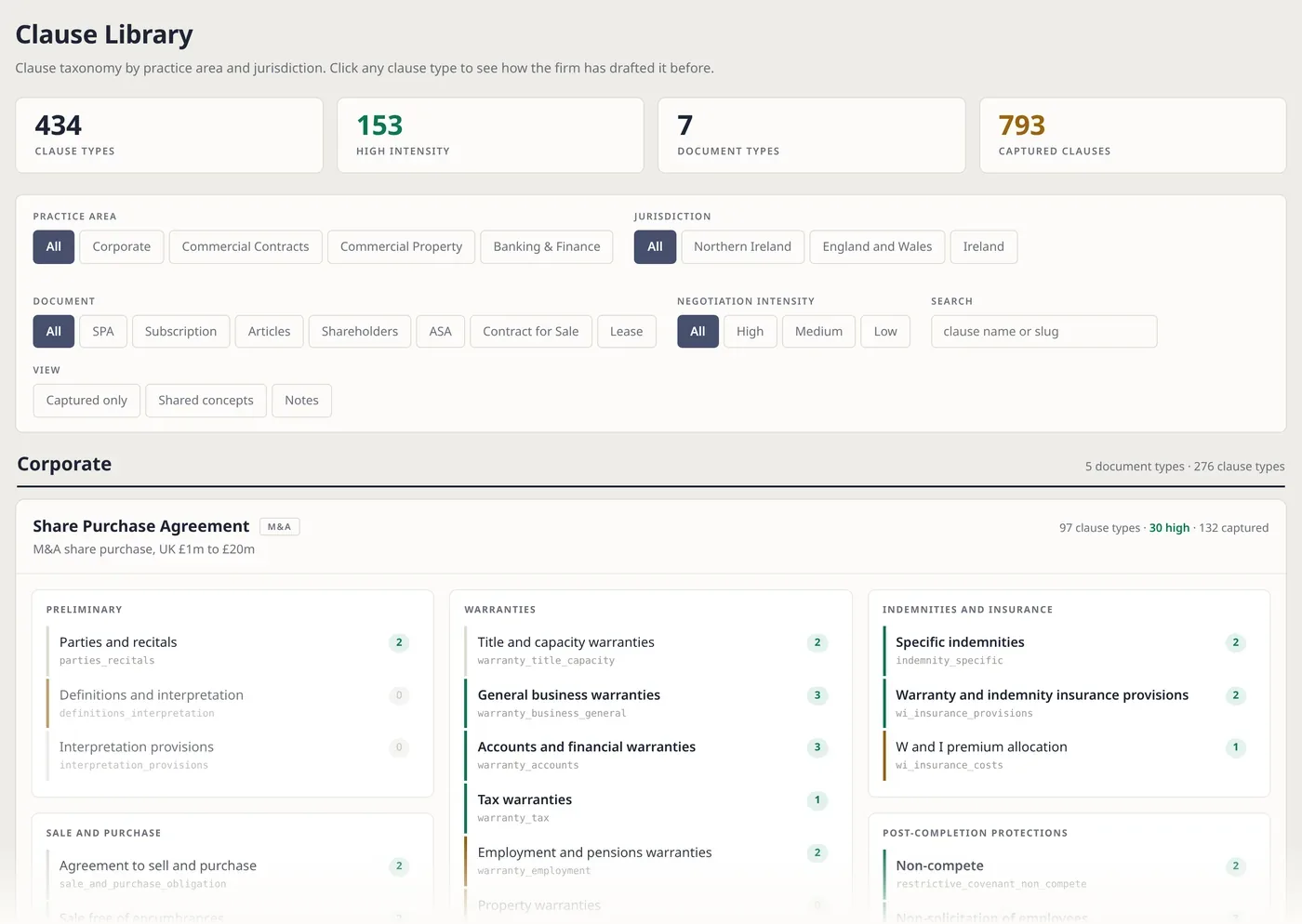
Clause types apply in Northern Ireland, England and Wales, and Ireland unless marked otherwise. Where the law differs, a jurisdiction note records how: a security of tenure provision, for example, can distinguish the Landlord and Tenant Act 1954, the Business Tenancies (Northern Ireland) Order 1996, and the Landlord and Tenant (Amendment) Act 1980 in Ireland. Concept tags mark positions that appear in more than one document, such as entire agreement or governing law. You can filter by practice area, jurisdiction, document or intensity, and narrow the view to types with captured wording, shared concepts or a drafting note.
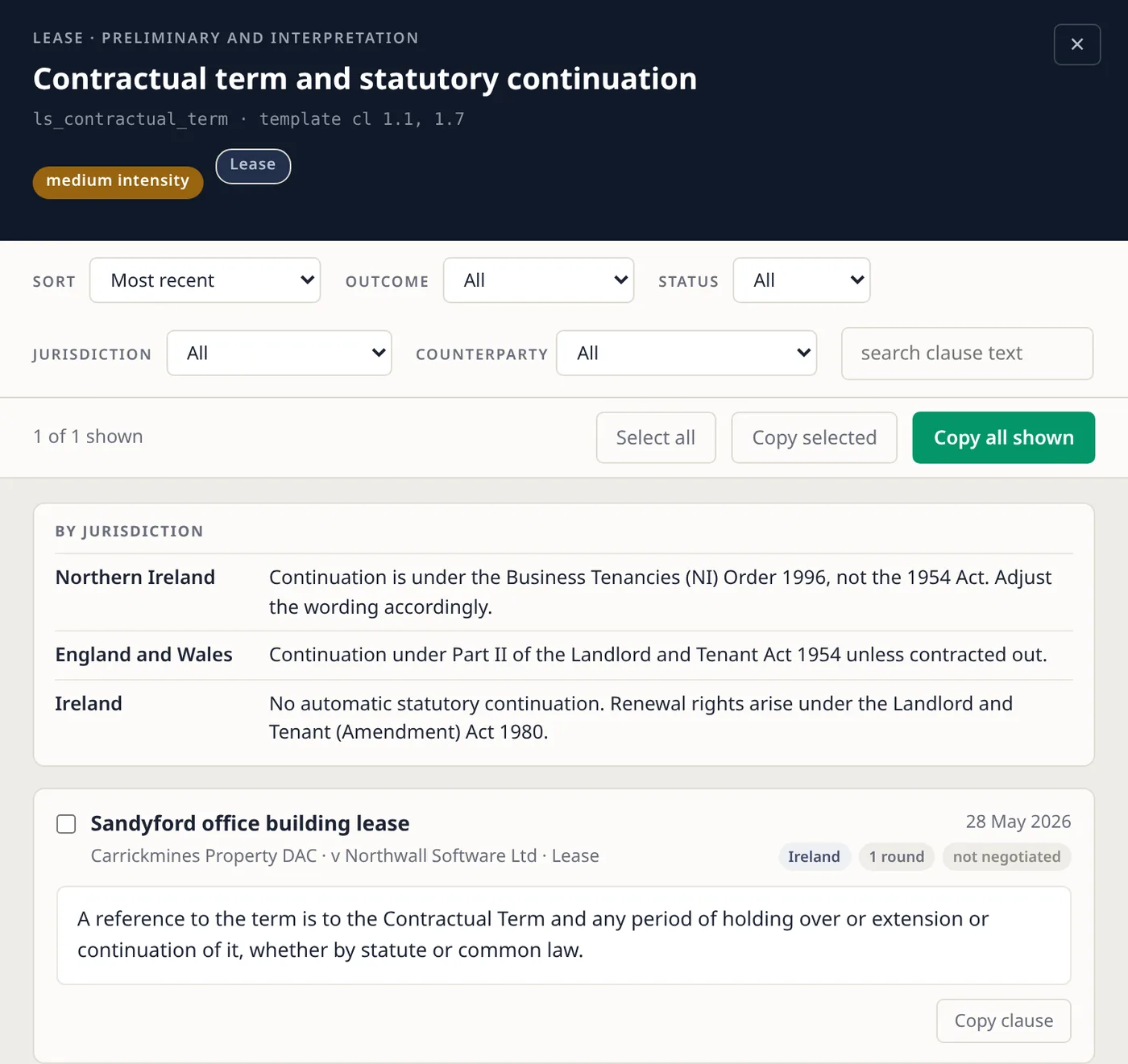
What do you see when you open a clause type?
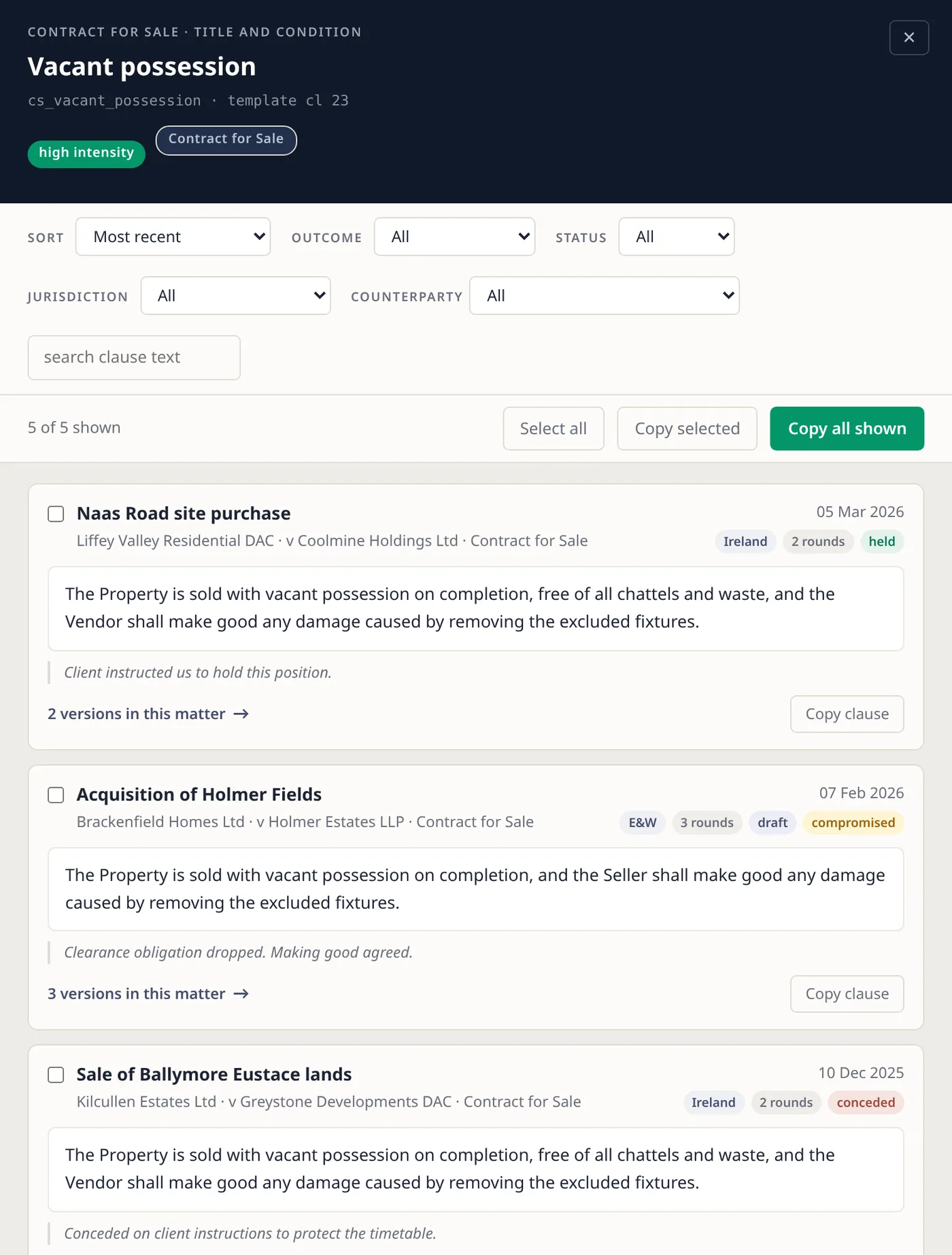
You see every captured instance from the firm's matters, with the matter, client, counterparty, document, date, jurisdiction, number of rounds, whether the wording is still a draft or has been released, and the outcome: held, compromised, conceded or not negotiated. A lawyer's note can sit with the instance. You can sort by recency, how heavily the clause was negotiated, matter or counterparty, and search the wording.
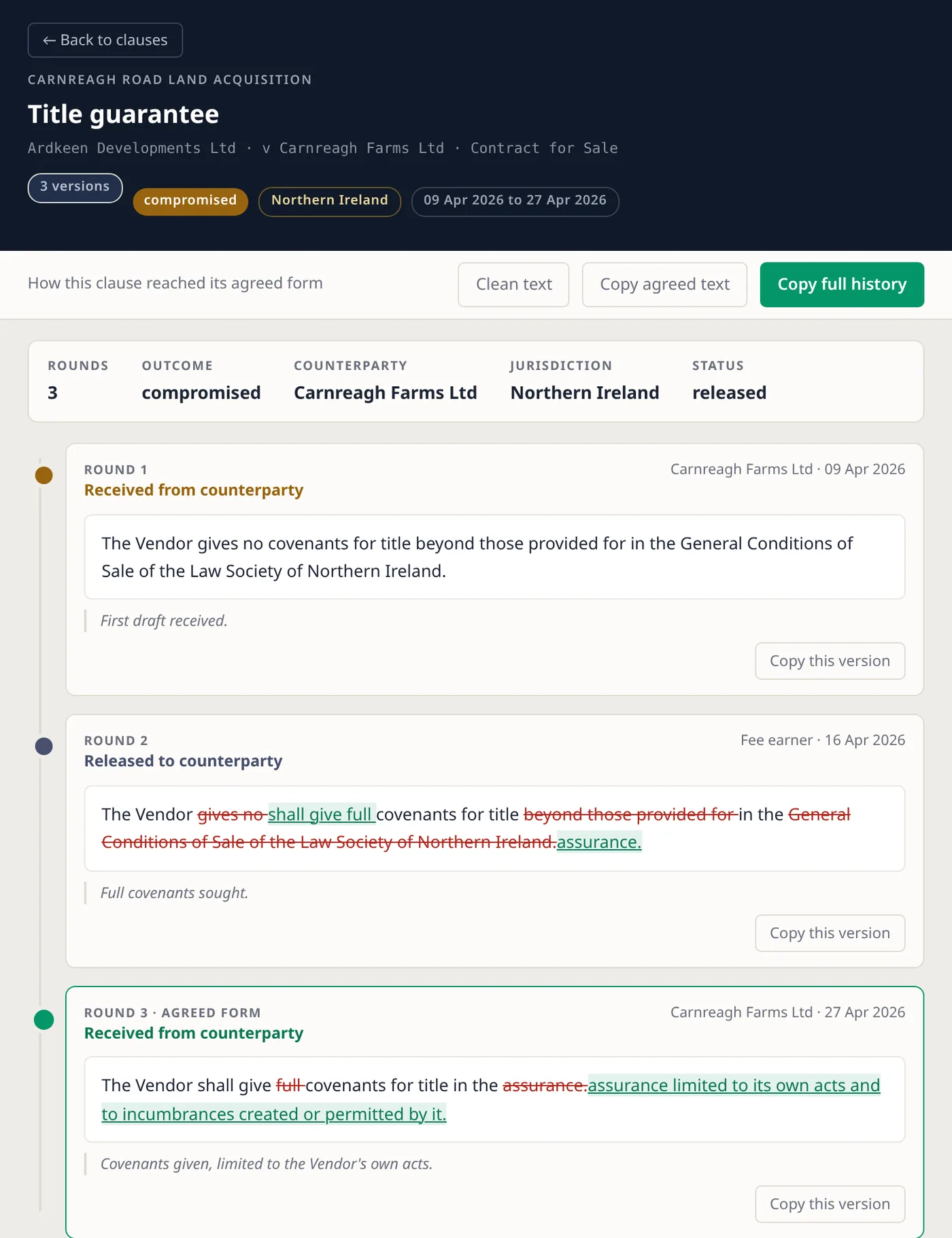
If a matter went through more than one version, you can open the history of how the clause reached its agreed form. Each round is labelled as an internal draft, wording released to the counterparty, or wording received from the counterparty, with a word-level comparison to the previous round. Questions and answers sit with that round. You can copy a version, the agreed text or the full history, with the matter, document, jurisdiction, date, round and outcome attached. A jurisdiction panel records where a type is not used, or where the wording needs to change.
The value of a clause library is not how many headings it contains, but how many of your own deals sit behind the clause you are about to reuse.
How does Scriptum compare with other clause libraries and legal AI tools?
Most tools in this market do one of three jobs well. Publisher clause banks, such as Practical Law or the LexisNexis contracts clause bank, give you expert market wording. Search-and-reuse tools, such as Definely's Vault, search the firm's documents or document management system and insert chosen clauses in Word. Playbook and platform tools, including Spellbook, Harvey, Legora and Microsoft Copilot for Legal, apply a playbook or precedents the firm has uploaded or encoded. Clarilis starts from maintained precedent suites; iManage searches templates and know-how already in the firm's repository.
Scriptum is closer to a record of the firm's own negotiated work than to a market formbook or a document-management search pane. Other tools usually start from approved or published wording, or from a written playbook. Scriptum's library is built around captured clauses from the firm's matters, with their outcomes and history attached. The broader product, including drafting in Word from the firm's precedents, is set out in what makes Scriptum different from other legal AI and in why Scriptum works inside Microsoft Word.
| Typical clause bank or knowledge library | Scriptum clause library | |
|---|---|---|
| Source of wording | Market-standard precedents, or clauses filed from a DMS | Clauses captured from the firm's own matters |
| Organisation | Folders, document names, or approved gold-standard lists | A taxonomy by practice area, document type and jurisdiction |
| What the history shows | Often the latest approved text only | Outcome, rounds to agree, and a word-level path to the agreed form |
| Jurisdictions | Often one jurisdiction's standard form | Northern Ireland, England and Wales, and Ireland, with notes where the law differs |
| How it stays current | A knowledge project, or synchronising filed precedents | Captured from work already done on matters, then mapped to the taxonomy |
A simplified comparison, not a ranking. Always test on your own matters.
Who is the Scriptum clause library built for?
Scriptum AI is built for transactional work at mid-sized firms with between 5 and 500 fee earners in the UK, Ireland, the USA and Canada. The clause library is included on every plan. Current prices are on our pricing page: Starter is £79 per user per month, Pro is £119, and Firm is priced custom. The firm owns the library. Our clause library product page shows the approach in more detail, and legal AI that builds knowledge your firm owns explains why that matters when people move on. See also who owns the knowledge your AI creates.
Want to see the library against your own documents? Book a demo and we will walk through a live matter with you.
Common questions
What is the Scriptum clause library?
It is a searchable record of how your firm has drafted and negotiated clauses, organised by practice area, document type and jurisdiction, with outcomes and, where there were several rounds, a history of how the wording reached the agreed form.
How is Scriptum's clause library different from Practical Law or a Lexis clause bank?
Practical Law and LexisNexis clause banks supply expert, maintained market wording. Scriptum's library is built from your firm's own matters: the wording, counterparty, jurisdiction, outcome and path to the agreed form.
How does it compare with Definely Vault or Spellbook?
Definely Vault and Spellbook are Word add-ins that help lawyers find and insert approved or precedent language, often from a document management system or an uploaded playbook. Scriptum is also a Word add-in, but its clause library is organised around captured clauses from the firm's matters, with outcomes and a round-by-round history.
Does the Scriptum clause library cover Northern Ireland and Ireland as well as England and Wales?
Yes. Clause types apply in Northern Ireland, England and Wales, and Ireland unless marked otherwise. Where the law differs, a jurisdiction note on the clause type records how the wording or statutory basis changes.
Who owns the clause library?
Your firm does, on every plan. The library is built from your matters and stays with the firm when people leave. Current prices are on the Scriptum pricing page.